
Critical minerals in 2026: why the refinery, not the mine, is the real bottleneck
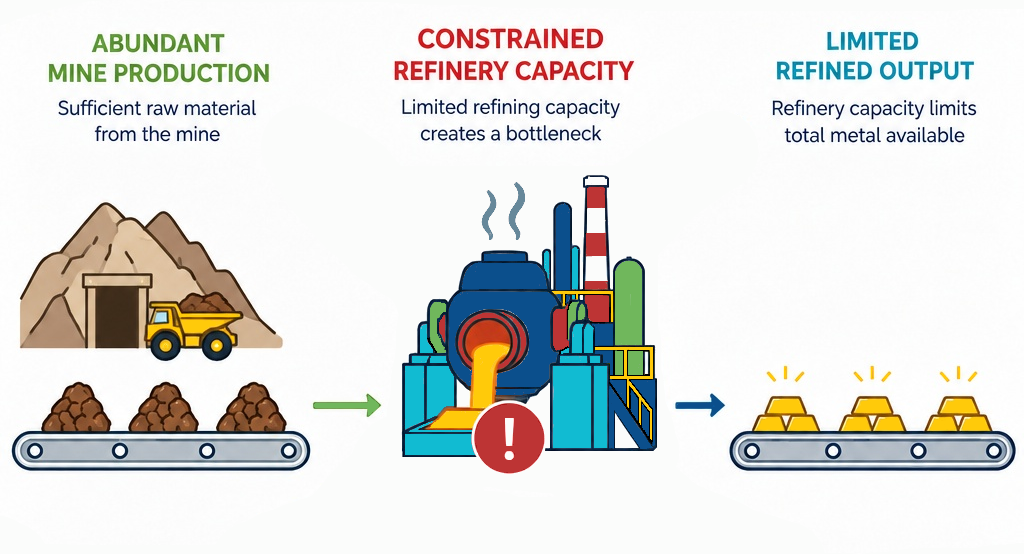
For a decade, the energy transition's mineral story has been told as a scarcity problem: not enough lithium, not enough copper, not enough rare earths in the ground to meet demand. The 2026 data points somewhere else. The minerals are, broadly, there. What has become scarce is diversity in who turns them into something usable.
What is the biggest risk in critical minerals supply in 2026?
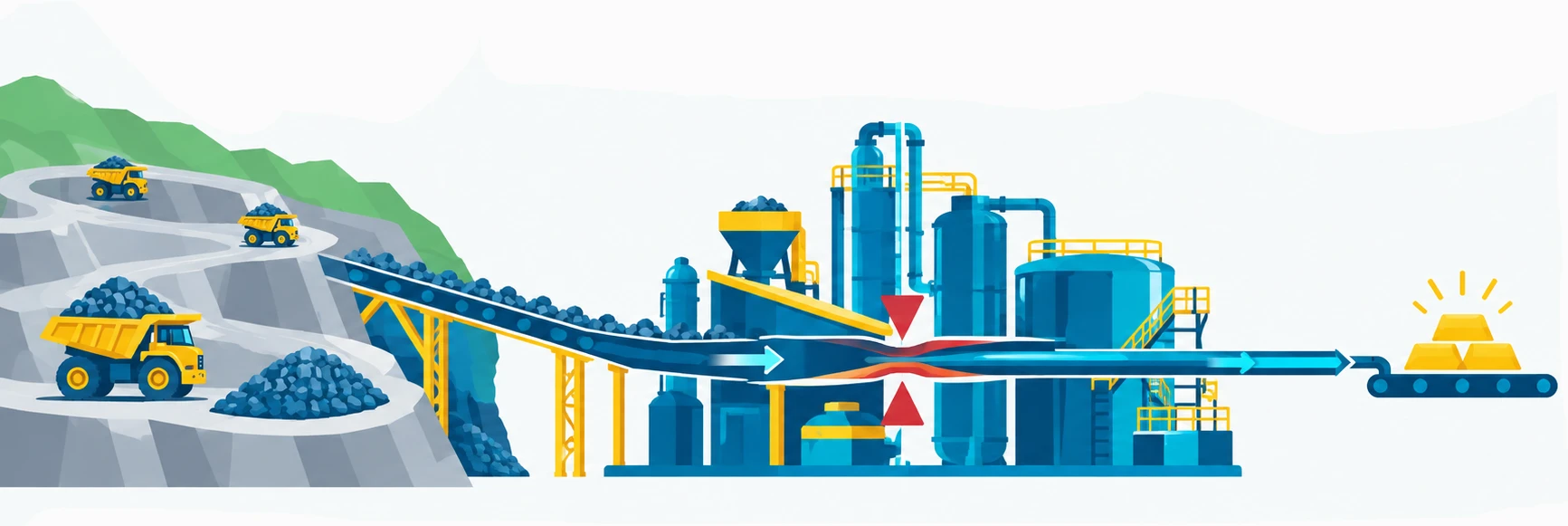
The biggest risk is refining concentration, not scarcity of the raw mineral itself. According to the International Energy Agency's Global Critical Minerals Outlook 2026, average refining concentration, the share held by the single largest refiner, reached 70% in 2025 across the twenty energy minerals the report tracks, up from 68% in 2020. China is the leading refiner for nineteen of those twenty minerals, and for gallium, graphite, manganese and rare earths, its share exceeds 90%. Indonesia, the leading nickel refiner, and China together accounted for over three-quarters of all supply growth between 2023 and 2025. That is not a story about whether enough material exists. It is a story about how few places can turn it into a usable product.
Is this only a scarcity story?
No, and that is the point the concentration data makes clearest. A mineral can be abundant in the ground and still represent serious supply risk if nearly all of it passes through one refinery, one country or one set of export rules on its way to market. The IEA's outlook notes that the number of mineral tariff codes subject to Chinese export controls has tripled since 2023, a direct measure of how quickly a concentration risk that looks theoretical on paper can turn into an actual supply event. Scarcity is a geology problem. Concentration is a business continuity problem, and it is the one 2026's data says is getting worse.
Why are metals prices rising at the same time?
Because supply tightness and strong demand are compounding, not because of any single shock. The World Bank's April 2026 Commodity Markets Outlook projects its metals and minerals price index up 17% year on year in 2026. Base metals are projected up 19%, with aluminium, copper and tin all forecast to reach all-time highs in 2026 before easing back in 2027. Precious metals are forecast up 42% to a record annual high, with gold and silver priced near four times their 2015 to 2019 average. Notably, iron ore is projected to fall on ample supply, so the rise is concentrated in the metals the energy transition actually needs, not commodities broadly. Rising prices and rising concentration landing in the same window is not a coincidence worth ignoring.
Why is investment falling just as concentration is rising?
Because the same uncertainty that is driving prices up is making investors more cautious about funding new, more diversified supply. The IEA's outlook records a 9% decline in critical mineral investment in 2025, ending several years of growth, as investors turned more cautious amid geopolitical tension and price volatility. Battery metals took the sharpest pullback, with capital spending down more than 20%, the largest decline in over a decade. That is the uncomfortable pairing at the centre of this theme: concentration is at a record high, prices are climbing, and the capital that would diversify supply away from that concentration is retreating rather than advancing. The market is not correcting this problem on its own.
Does this only affect the newest energy-transition metals?
McKinsey's Global Materials Perspective puts more than half of total materials demand growth to 2035 down to the energy transition and digitalisation, led by copper, lithium and rare earths, with supply concentration across mining and refining up 3 to 5 percentage points over the past five years. And metals have already shown they can move independently of the wider commodity market. In a separate McKinsey analysis of 2025 commodity trading, metals moved the other way from the wider market: monetisation potential for metals actually rose by around 29% even as their volatility fell by around 26%, the only commodity class in the data to move in that direction, at a time the wider market saw volatility ease and its predictability drop by around 13%. A book that includes metals cannot be read off the wider market's trend. It behaves differently, for reasons rooted in exactly the concentration this article is about.
What should a concentrates and refined metals desk actually do about it?
See the exposure by refining origin and counterparty, not just by commodity total. A position report that says "we hold 4,000 tonnes of copper" answers the wrong question in a market where 70% of refined output can trace back to one country. The more useful question is how much of that copper exposure sits behind a single refining origin, and what happens to the book if an export rule or a supply disruption hits that specific source rather than the commodity in general. That is a visibility and granularity requirement, not a forecasting one: nobody can predict the next export control, but a firm can make sure it knows, in real time, exactly where its concentration risk sits. That granular, real-time view of exposure by counterparty and origin, sitting inside concentrates and refined metals trading specifically, is what Amphora's CTRM platform exists to provide.
Does this only matter to metals-only trading firms?
No. Firms trading a wider commodity portfolio, energy, agriculture, freight, alongside a metals sleeve carry the same concentration risk inside that one part of the book, and it is easy to miss if the metals position is just one line inside a much larger multi-commodity report. A consolidated, real-time view across the whole portfolio, granular enough to show refining-origin and counterparty concentration within the metals allocation specifically, is the same discipline this series argued for on volatility, applied here to supply-chain concentration. That whole-book view is what Amphora's CTRM platform is built to provide.
What is the practical test of readiness?
The useful test is not "do we have enough of this mineral." It is "do we know, right now, how much of our exposure to this mineral runs through the one supplier or the one country that dominates its refining." If the honest answer takes a spreadsheet reconciliation to produce, the concentration risk 2026's data describes is already sitting inside the book, unseen. The question worth retiring is whether the world has enough critical minerals. The question worth asking instead is how exposed any single firm is to the handful of places that turn those minerals into something tradeable.
Frequently asked questions
What is critical minerals refining concentration?
Refining concentration measures how much of a mineral's global refined supply passes through a single country or company. The IEA's Global Critical Minerals Outlook 2026 found this reached a record average of 70% across the twenty energy minerals it tracks in 2025, meaning most of the risk sits at the refining stage, not the mining stage.
Which country dominates critical minerals refining?
China is the leading refiner for nineteen of the twenty energy minerals the IEA's 2026 outlook tracks, with an average market share of around 70%, and a share exceeding 90% for gallium, graphite, manganese and rare earths.
Are critical minerals and metals prices rising in 2026?
Yes. The World Bank's April 2026 Commodity Markets Outlook projects its metals and minerals price index up 17% for the year, with base metals up 19% and aluminium, copper and tin all forecast to reach all-time highs, alongside a forecast 42% rise in precious metals to a record annual high.
Is critical mineral investment keeping pace with demand?
No. The IEA's 2026 outlook records a 9% decline in critical mineral investment in 2025, with battery metals capital spending down more than 20%, even as prices and refining concentration both rose over the same period.
How does a CTRM system help a concentrates and refined metals desk manage concentration risk?
A commodity trading and risk management system built for concentrates and refined metals gives a trading firm a real-time, granular view of its exposure by refining origin and counterparty, not only by commodity total, so a supply disruption or export control affecting one source shows up immediately rather than after the fact.
Who is Amphora?
Amphora is a London-based commodity trading and risk management software company, founded in 1997.
- International Energy Agency, Global Critical Minerals Outlook 2026: iea.org/reports/global-critical-minerals-outlook-2026
- World Bank, Commodity Markets Outlook, April 2026 edition: worldbank.org/en/research/commodity-markets
- McKinsey & Company, Global Materials Perspective: mckinsey.com/industries/energy-and-materials/our-insights/global-materials-perspective
- McKinsey & Company, "At the threshold of a new era in commodity trading", 3 March 2026: mckinsey.com/industries/energy-and-materials/our-insights/at-the-threshold-of-a-new-era-in-commodity-trading
- USGS, Mineral Commodity Summaries 2026 / National Minerals Information Center: usgs.gov/centers/national-minerals-information-center
Amphora is a global leader in commodity trading and risk management (CTRM) software, built for complexity and proven for over 30 years. Its Symphony and Alchemy platforms support the full trade lifecycle for firms trading crude oil, refined products, biofuels, coal, ore, LNG, metals and concentrates, delivered on a single-branch, highly configurable architecture with no forked code bases and no scripting. Amphora is delivered end-to-end by Amphora personnel from development and service centres in Dubai, the UK, India and the USA. Learn more at amphora.net.